
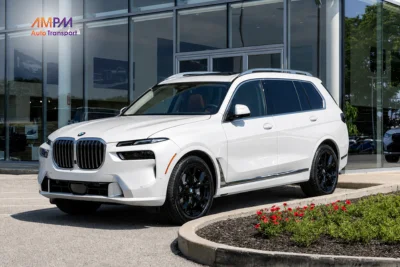
The BMW X7 is not a vehicle that tries to disappear into traffic. Its upright body, split headlights, broad shoulders, and enormous kidney grille make sure of that. Some drivers see the front end as bold and unmistakably modern. Others still need time to get used to it.
Either way, nobody is likely to mistake the X7 for something else. The design may attract the first look, but the 2026 BMW X7 makes its strongest argument once the doors close. This is a large three-row SUV that can carry up to seven people, yet it still has the steering response and strong acceleration people expect from BMW. That is not an easy balance to create. Many full-size luxury SUVs feel comfortable but distant. They are pleasant places to sit, though the person behind the wheel may feel more like an operator than an active part of the trip. The X7 takes a different approach. Standard all-wheel drive, air suspension, accurate steering, and a choice of powerful engines give it more energy than its size suggests. Car and Driver gave the 2026 model a 9.5-out-of-10 rating, praising its agility, passenger comfort, and polished engine lineup.
There are compromises. The third row is not as roomy as the ones in some competing full-size SUVs. Cargo space becomes tight when every seat is occupied, and the curved-screen infotainment system may require a little practice. Large available wheels can also make rough pavement feel less forgiving. The X7 is expensive too. The 2026 lineup spans from roughly $89,000 to more than $181,000 before optional equipment and other charges, depending on the model. Still, the X7 does something many luxury vehicles struggle to do. It makes ordinary driving feel a little less ordinary. A grocery trip remains a grocery trip. School pickup is still school pickup. But when the cabin is quiet, the engine responds immediately, and the suspension smooths out a damaged road, those daily tasks feel easier. That may be the real meaning of luxury.
What Makes the 2026 BMW X7 Different?
The X7 sits at the top of the regular BMW SUV models. It is larger than the X1, X3, X5, and X6, with three rows and seating for up to seven. Buyers can also choose second-row captain’s chairs, which reduce seating capacity to six but create a more comfortable middle row and easier access to the back. BMW describes the X7 as its largest SUV and offers the model with a standard second-row bench or an available six-seat arrangement.
The 2026 model is largely unchanged from the previous year. BMW removed Ametrin Red Metallic from the available paint list and discontinued the gesture-control feature that allowed users to perform certain infotainment tasks with hand movements. A limited Alpina XB7 Manufaktur edition also joined the lineup for the final production run of that version. Otherwise, the X7 continues with the same basic design and mechanical setup. That is not necessarily a weakness. The current X7 already has the equipment expected from a flagship luxury SUV. It includes standard all-wheel drive, adaptive air suspension, a large curved digital display, heated front seats, a panoramic roof, ambient lighting, and a cabin filled with upscale materials.
The exterior remains the most controversial part. BMW’s double kidney grille has been growing across several models, but the X7 gives it enough space to become the main feature of the entire front end. Vertical bars fill the grille, while slim daytime running lights sit above the main headlights. BMW describes the design as a combination of a commanding grille, slim lighting, and wide proportions. It looks especially dramatic in a rearview mirror. Whether the grille is attractive depends on personal taste. It does make sense in relation to the rest of the vehicle. The X7 is more than 200 inches long, sits high above the road, and has the visual weight of a full-size SUV. A small, delicate grille might look lost on a body this large.
The split-light arrangement helps lower the visual center of the front end. The daytime running lights create a narrow upper line, while the main headlamp units sit lower in the bumper. From the side, the styling becomes more traditional. The roof remains relatively straight instead of falling sharply toward the rear. That gives the third row more headroom and provides a more useful cargo opening than the coupe-like BMW X6.Large windows help the cabin feel open, while the long wheelbase creates space between the three rows. Satin aluminum trim is standard on some versions, while M Sport equipment replaces brighter exterior details with darker pieces. The result is a vehicle that can look elegant or aggressive depending on the selected wheels, paint, and trim.
Wheel sizes begin at 21 inches and can reach 23 inches. The largest wheels fill the arches and strengthen the X7’s road presence, but they come with a practical downside. Car and Driver found that the ride becomes less comfortable over patched or broken pavement when the SUV is riding on the biggest available wheels. That is worth considering before choosing based only on appearance. A 23-inch wheel may look excellent in a dealership. The smaller setup may feel better after two hours on a rough highway. The X7 is designed to cover both luxury and utility, though it leans more heavily toward comfort.
When equipped with the factory-installed hitch, the 2026 model can tow up to 7,500 pounds. That is enough for many boats, campers, and recreational trailers, although actual towing capability depends on the trailer, cargo, passengers, equipment, and proper weight distribution. Standard xDrive all-wheel drive also helps manage traction during rain, snow, and changing road conditions. This does not turn the X7 into a rugged off-road vehicle. Its size, wheels, tires, bodywork, and luxury-focused design make it more at home on pavement. But it can handle the situations a large family SUV is likely to encounter: winter travel, wet highways, gravel driveways, mountain roads, and a loaded trailer. The X7’s real difference is not one feature. It is the combination of three-row space and BMW road manners.
From the xDrive40i to the BMW X7 M60i
The 2026 X7 lineup offers three very different levels of performance. The xDrive40i uses a turbocharged inline-six. The BMW X7 M60i moves to a twin-turbo V8. At the top sits the Alpina XB7, which takes the V8 and adds even more power, speed, luxury, and exclusivity. All three use an eight-speed automatic transmission and standard all-wheel drive. Every model also rides on an adaptive air suspension, while active anti-roll technology helps control body movement through corners. The xDrive40i is the version most buyers are likely to need. Its turbocharged 3.0-liter inline-six produces 375 horsepower. That may sound modest next to the V8 models, but the engine has no trouble moving the large SUV. Car and Driver recorded a zero-to-60-mph time of 4.6 seconds, which is quicker than many smaller vehicles marketed as sporty. The inline-six also fits the character of the X7.
Power arrives smoothly, the transmission works quietly, and the engine does not need to feel dramatic to make progress. It has enough strength for highway merging, loaded family trips, and normal towing without making every press of the accelerator an event.
Fuel economy is also more reasonable than it is in the V8 versions. The xDrive40i carries EPA estimates of 20 mpg in the city and 24 mpg on the highway. Those numbers are not economy-car figures, but they are respectable for a three-row luxury SUV of this size and performance level. For many drivers, this is the balanced X7.It provides the same basic cabin, exterior dimensions, seating capacity, and luxury experience as the more expensive versions.
The difference becomes clear when the road opens and the driver asks for everything the engine can deliver. That is where the X7 M60i enters the picture. Its twin-turbocharged 4.4-liter V8 produces 523 horsepower. Rear-axle steering is standard, and the suspension receives a sportier setup. Car and Driver recorded a 3.8-second run from zero to 60 mph, an extraordinary result for a large SUV with three rows of seats. The M60i does not feel merely quicker than the six-cylinder version. It feels more urgent.
Press the accelerator and the SUV gathers speed with very little hesitation. The V8 supplies stronger low-speed force, while the transmission keeps the engine ready without becoming rough during normal driving. The sound is deeper too, though the cabin remains well insulated. This creates a strange but entertaining experience. The driver sits high in a vehicle large enough to carry a family and luggage, yet the acceleration belongs in a serious performance car. The M60i also includes additional M design details and chassis tuning. It is not a full X7 M in the same sense as an X5 M Competition, but it moves the X7 closer to BMW’s performance side.
Fuel use reflects that change. The M60i is rated at 16 mpg in the city and 20 mpg on the highway. Car and Driver achieved 23 mpg during its 75-mph highway test, showing that calmer long-distance driving can produce better results than the city rating suggests. Still, a buyer choosing the V8 should expect higher fuel costs. The extra performance may not matter during a slow commute. It becomes much easier to appreciate on a highway entrance, mountain pass, or open road with several passengers inside.
Then there is the Alpina XB7.Its specially tuned twin-turbo V8 produces 630 horsepower. The model combines extremely strong performance with its own wheels, interior details, suspension calibration, and luxury equipment. The XB7 is not simply a faster M60i.Alpina traditionally takes a grand-touring approach. The goal is to combine speed with comfort rather than creating the most aggressive track-focused setup. That makes sense for the X7. Few owners are likely to take a three-row SUV to a racetrack. More will use it for long highway trips, airport transfers, family travel, and daily driving. The XB7 provides enormous power without asking the vehicle to abandon those duties. It is also the most expensive version by a considerable margin. The 2026 X7 range reaches beyond $181,000 at the top end, placing a highly equipped or limited Alpina in the territory of far more exotic vehicles.
Choosing among the three depends less on need than on personality. The xDrive40i is already fast, smooth, and capable. It is the sensible choice without feeling like a compromise. The M60i is for someone who wants the V8 experience every time they press the accelerator. It adds speed and character without changing the X7’s basic usefulness. The XB7 is the rare choice. It is for a buyer who wants the largest BMW SUV with a level of power, detail, and exclusivity that few other vehicles offer. The regular BMW X7 2026 lineup does not include a weak model. The question is how much performance belongs in everyday life and how much the buyer is willing to spend to get it.
Inside the X7: Three Rows Without Giving Up the Driver
The X7’s exterior is designed to attract attention. The interior takes the opposite approach. It is meant to make the outside world feel quieter. Soft surfaces, ambient lighting, large displays, available glass controls, and an expansive panoramic roof give the cabin a modern luxury atmosphere. The dashboard wraps gently around the front occupants, while the high seating position provides a clear view of surrounding traffic. The cabin can seat seven with a second-row bench or six with individual captain’s chairs. That flexibility is important because the two layouts serve different families.
The First Two Rows Feel Properly Luxurious
Front passengers receive the space and comfort expected from a flagship SUV. Heated front seats, a panoramic sunroof, a power-adjustable steering wheel, and ambient lighting are among the features available or included in the X7 cabin. BMW also offers upgraded upholstery, trim, climate systems, massaging seats, and premium audio equipment depending on the model and selected packages. The driving position is upright without feeling bus-like. The steering wheel comes toward the driver, the pedals are positioned naturally, and the dashboard does not seem excessively far away despite the width of the cabin. Second-row comfort depends partly on the seating layout.
The standard bench carries three people and preserves the seven-seat capacity. Captain’s chairs create more separation and allow passengers to adjust their seats independently. They also open a narrow path toward the third row, though moving through the center is not always as simple as it appears. Car and Driver found the power-operated captain’s chairs slow when passengers were trying to access the back.
Families should test both configurations. Captain’s chairs look more luxurious and give two passengers additional personal space. A bench may be more practical for families that need three child seats, carry seven people frequently, or prefer a flat second row when the seats are folded. There is no universally better layout. It depends on who will sit there.
The Third Row Works Better for Some Passengers Than Others
The X7 is a genuine three-row SUV, but the last row is not equally comfortable for every passenger. Children and smaller adults should fit reasonably well. Taller adults may feel restricted during longer drives, particularly in legroom. Car and Driver identifies the third row as one of the X7’s weaker areas compared with larger competitors such as the Cadillac Escalade and Mercedes-Benz GLS. Getting into the back also requires some patience. The second-row seat moves forward electrically, and the process can feel slow when someone is waiting in the rain, carrying bags, or trying to load several passengers at once. Once seated, third-row occupants still benefit from the X7’s tall roof and upscale surroundings.
They are not sitting in a bare emergency bench. Even so, families planning to carry adults in all three rows every day should spend time back there before buying. A short showroom sit may not reveal what the space feels like after an hour. The X7 makes more sense as a luxury vehicle for four or five people that can occasionally carry six or seven. It is less convincing as a full-time seven-adult shuttle.
Cargo Space Changes Quickly With the Seats
Cargo space behind the third row is limited. Car and Driver fit only three carry-on suitcases behind the last row. With the rear seats folded, however, the same test accommodated 33 carry-ons. That difference explains the X7’s practical personality. With every seat occupied, there is room for daily bags and a small grocery trip, but a family of seven heading to the airport may need to pack carefully or add external storage.
Fold the third row and the SUV becomes far more useful. There is enough space for luggage, sports equipment, home-improvement supplies, pet gear, or the boxes that appear during a college move. Folding the second row creates a much larger cargo area for occasions when passenger space is not needed. The seats operate electrically, which makes changing the layout easier but not always faster. Pressing a button is convenient.
Waiting for several powered seatbacks to move can take longer than pulling a manual release. Small-item storage is more generous. Car and Driver praised the cabin’s cubbies, while the center console, door pockets, cupholders, and covered storage areas give passengers places to keep phones, snacks, cables, and travel items. That matters in a family vehicle. A luxury cabin can look impressive in photographs and still become frustrating when nobody has a place to put a water bottle. The X7 handles everyday clutter better than its polished interior might suggest.
The Curved Display Looks Clean but Takes Practice
The dashboard is dominated by BMW’s curved display. It combines a 12.3-inch digital gauge cluster with a 14.9-inch infotainment touchscreen beneath one continuous glass surface. The system can also be controlled with the rotary iDrive controller on the center console. The setup looks modern and reduces the number of separate panels across the dashboard. It also places many vehicle settings inside digital menus. Some drivers will appreciate the flexibility.
The display can show navigation, media, driving information, phone functions, vehicle settings, and camera views. Others may miss having a dedicated physical button for every climate or comfort feature. The rotary controller helps. It allows the driver to move through menus without reaching toward the screen, which can feel more stable on a rough road. Voice commands and steering-wheel controls provide additional ways to manage common functions. Even so, the system has a learning curve. Car and Driver lists the infotainment interface among the X7’s weaker points. The best approach is to set up personal shortcuts and profiles early.
Once the driver’s preferred seat position, climate settings, display arrangement, audio source, and phone connection are stored, daily use becomes much simpler. The X7 also offers BMW Digital Key technology, allowing a compatible smartphone to perform certain key functions. Available premium audio systems include Harman Kardon and a higher-end Bowers & Wilkins setup. BMW’s current X7 equipment also includes available features such as five-zone climate control, a head-up display, augmented navigation guidance, and a Bowers & Wilkins system with up to 36 speakers. Availability varies by configuration and model year, so buyers should check the exact vehicle rather than assuming every X7 includes the same equipment. That last point matters with luxury SUVs. A base model and a heavily optioned example can look almost identical from the outside while feeling completely different inside.
Is the 2026 BMW X7 Right for Everyday Life?
The X7 makes the most sense for someone who needs real passenger space but does not want driving to feel like a chore. It can carry children, adults, luggage, groceries, and weekend equipment. It can tow when properly equipped, manage winter roads with standard all-wheel drive, and cover long highway trips without leaving passengers exhausted. At the same time, it responds like a BMW. The steering is accurate, the engines are strong, and the suspension controls the body more carefully than many vehicles of this size. Car and Driver found the X7 unusually agile for a large SUV, which is one of the main reasons it stands above many competitors. The xDrive40i is likely the best everyday version for most buyers.
Its 375-horsepower inline-six is already quicker than many people will expect, while its fuel economy is easier to accept than the V8’s. It provides the same three rows, curved display, air suspension, and basic luxury environment without moving the price as high as the performance models. The BMW X7 M60i is harder to justify logically and easier to understand emotionally. Nobody needs a three-row SUV that reaches 60 mph in 3.8 seconds. Some drivers will enjoy knowing that it can. The V8 makes the X7 feel lighter and more responsive than it really is. Passing becomes effortless, highway entrances become entertaining, and the sound gives the vehicle more character.
That performance comes with higher fuel use and a much larger purchase price. The Alpina XB7 goes further still. It is faster, rarer, and more expensive, with enough exclusivity to appeal to someone who does not want the same luxury SUV parked at every hotel entrance. For most families, the extra performance is not necessary. Comfort options may be more useful than horsepower.
Captain’s chairs, the right upholstery, driver-assistance equipment, a quieter cabin, upgraded audio, and a wheel size that preserves ride quality can affect every trip. Additional engine power matters only when the driver asks for it. That is why buyers should resist building an X7 entirely from the outside. Large wheels and dark trim may create the perfect appearance. Smaller wheels and better comfort equipment may create the better vehicle to live with. Third-row use deserves the same honesty.
The X7 works well when the back seats are needed occasionally or used by children. A family carrying tall adults in the third row every day may find the Mercedes-Benz GLS or Cadillac Escalade more accommodating. The X7 also gives up cargo room when all seven seats are raised. Drivers who rarely need a third row may be happier with the smaller BMW X5.It costs less, is easier to park, and provides many of the same engines and technology.
The X7 earns its additional size when the extra passenger capacity, cargo flexibility, and larger cabin are genuinely useful. Then there is the styling. The grille will remain a deciding factor for some people. It is large, not subtle and may look excessive in photographs and feel more natural when seen as part of the full vehicle. BMW did not design the X7 to please everyone. That confidence fits the SUV.A full-size flagship should not look like a smaller model enlarged on a photocopier. The X7 has its own presence, and the grille is central to that identity. The vehicle behind it is more thoughtful than the front-end discussion sometimes suggests.
The X7 can be calm during a school run and surprisingly quick when the road clears. It can carry seven people, though it is most comfortable with fewer. It offers advanced technology without completely removing traditional driving involvement. Most importantly, it gives the person behind the wheel something to enjoy. That is not always true in a large family SUV. The 2026 BMW X7 feels special not because every trip is exciting, but because even the unexciting trips require less effort. The cabin is comfortable, the engines rarely feel strained, and the vehicle seems smaller once it begins moving. It is bold from the outside. From behind the wheel, it is remarkably easy to live with.