
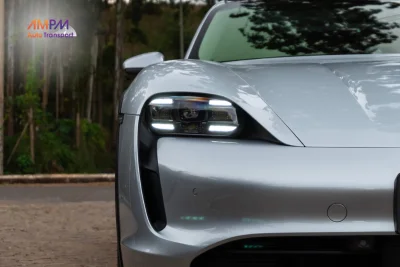
Electric cars are naturally quick. Press the accelerator and the power arrives immediately, without an engine building speed or a transmission working through several gears. That used to be enough to make an EV feel exciting. Not anymore. Now that family sedans and large electric SUVs can reach 60 mph in only a few seconds, speed alone does not make a performance car special. The harder job is giving the driver a reason to take the longer road home. That is where the Porsche Taycan stands apart.
It is low, wide, and built around the person behind the wheel. The steering communicates what the front tires are doing. The seating position feels closer to a sports car than a luxury sedan, and the suspension keeps the body controlled without turning every cracked road into punishment. The Taycan is unmistakably a Porsche electric car, yet it does not feel like Porsche simply removed a gasoline engine and filled the empty space with batteries. The company approached the car differently.
It developed an 800-volt electrical system for quick charging, fitted a two-speed rear transmission, and created a model range that stretches from a relatively restrained rear-wheel-drive car to the 1,019-horsepower Porsche Taycan Turbo GT. There are compromises. The back seat is tight for taller adults, the trunk is not especially large, and the options list can turn an already expensive vehicle into something much more costly. Still, the Taycan gets the important part right. It does not ask drivers to lower their expectations because it happens to be electric. It simply finds a new way to meet them.
What Makes the Porsche Taycan Feel Like a Porsche?
Porsche has spent decades refining cars that respond quickly and predictably to the person driving them. The Taycan had to create that same feeling while carrying a heavy battery pack beneath the cabin. That is not an easy task. Batteries add weight, and weight can make a car feel slow to change direction even when its acceleration is extraordinary. The Taycan never completely hides its size or weight. It does something more useful: it manages them. The driver sits low, the steering feels direct, and the car remains composed through quick transitions. Car and Driver praised the Taycan’s communicative steering and precise handling, noting that its driving position and chassis behavior distinguish it from many other electric vehicles.
Air suspension is standard across the lineup. Porsche Active Ride is available on certain models and can reduce body movement while also filtering out rough pavement. The system helps the car remain relatively flat through corners without forcing passengers to accept a harsh ride everywhere else. That balance matters more than a dramatic launch. An EV can be incredibly fast in a straight line and still feel disconnected once the road begins to curve. The Taycan gives the driver confidence to place the car where they want it. The model range begins with a single-motor, rear-wheel-drive version. Other models add a front motor and all-wheel drive. Depending on the configuration, output ranges from just over 400 horsepower to more than 1,000 horsepower with launch control.
Even the least powerful Taycan is not slow. Car and Driver recorded a 4.1-second run from zero to 60 mph in the rear-wheel-drive model. The Taycan 4 completed the same sprint in 4.0 seconds, while a tested 4S needed only 3.1 seconds. Those numbers are enough to make the base versions feel serious in everyday driving. The faster models move into a different category. The Taycan GTS produces up to 690 horsepower with launch control. The Taycan Turbo S can briefly deliver 938 horsepower, while the Taycan Turbo GT raises that figure to 1,019 horsepower. Car and Driver recorded a 1.9-second zero-to-60-mph time from both the regular Turbo GT and the more track-focused Weissach version. That is the kind of acceleration that makes the body feel pressed into the seat before the mind fully processes what is happening.
The Taycan also uses a two-speed transmission at the rear axle. Most electric vehicles rely on a single-speed reduction gear because electric motors operate effectively across a wide range of speeds. Porsche added a second gear to support strong initial acceleration while improving performance and efficiency at higher speeds. The driver does not operate it like a traditional manual or automatic transmission. There is no need to manage shifting during a commute. It simply works behind the scenes. Still, the two-speed arrangement helps give the Taycan a different character from the usual Porsche EV competitor. The braking experience also deserves attention.
Electric vehicles can use their motors to slow the car and recover energy. Porsche does not make heavy one-pedal driving the center of the Taycan experience. The car is designed to feel more like a conventional performance model when the driver presses the brake pedal. That approach may disappoint someone who enjoys aggressive regenerative braking around town. It makes sense for a car intended to provide predictable pedal response during quick driving. The Taycan is not trying to turn every unfamiliar EV behavior into a feature. It keeps what works and changes what it needs to.
Range, Charging, and the Reality of Owning a Porsche EV
The Taycan can be thrilling on the right road, but most owners will spend far more time thinking about traffic, parking, charging, and the distance remaining on the battery display.
That is where a Porsche electric model has to function like a normal car. For the recent Taycan lineup, EPA-estimated range varies by battery and trim. Car and Driver reports figures between approximately 252 and 318 miles. Some competitors can travel farther, but published range does not always reveal how an EV will perform during actual highway driving. In Car and Driver’s 75-mph range test, a Taycan 4S traveled 330 miles. The much more powerful Turbo GT completed 270 miles under the same type of testing. That difference makes sense. Larger wheels, wider tires, added power, aerodynamic changes, temperature, speed, and driving style all affect energy use. A calm highway trip in a 4S will not produce the same result as repeated hard acceleration in a Turbo GT.
Weather matters too. Cold temperatures can reduce available range because the vehicle needs energy to warm the battery and cabin. Extreme heat can also increase consumption when the air conditioning and battery cooling systems are working hard. A driver planning a long trip should not treat the maximum estimate as a guaranteed distance. Charging speed may be more important than the final range number. With the larger Performance Battery Plus, the Taycan can accept DC fast charging at up to 320 kW. Porsche says the battery can charge from 10% to 80% in approximately 18 minutes under ideal conditions. Car and Driver charged a Turbo GT from 10% to 90% in 24 minutes during testing. That is fast, but the words “ideal conditions” matter. The charger must be capable of delivering enough power.
The battery needs to be at the right temperature, and its current charge level affects how quickly it can accept electricity. Fast charging is generally quickest when the battery is relatively low. The charging rate usually slows as the battery approaches full capacity. A station advertising 350 kW does not guarantee the car will receive that output during the entire session. For daily ownership, home charging changes the experience more than any public-station specification. A driver who plugs in overnight may begin each morning with enough range for commuting, errands, and school trips. There may be no need to visit a public charger during a normal week. Someone without dependable home or workplace charging faces a different situation. Public charger location, reliability, availability, and pricing become part of regular ownership.
That does not make the Taycan impractical. It simply means the charging plan should be considered before the car arrives in the driveway. Long-distance travel requires some preparation too. The navigation system can plan routes around charging stops and consider the battery’s condition. A short charging stop can fit naturally into a meal or coffee break, but holiday traffic and crowded stations may change the plan. The smartest approach is to avoid arriving at a remote charger with almost no battery remaining. Leave room for a closed station, slower-than-expected charging, poor weather, or an unexpected detour.
A performance EV creates another temptation: using the acceleration constantly. The Taycan makes it very easy to move quickly away from a light or pass slower traffic. Repeated hard acceleration uses more energy, even when it feels almost effortless from the cabin. Range anxiety is sometimes blamed entirely on the vehicle. In reality, the driver’s habits can change the result considerably. That is part of learning any electric car. A gasoline vehicle also becomes less efficient at high speed or under heavy acceleration. The difference is that an EV shows the consequences immediately on the range display.
Inside the Porsche Taycan: Sporty, Digital, and Surprisingly Comfortable
The Porsche Taycan interior does not look like a traditional luxury sedan filled with polished wood and rows of buttons. It feels modern, low, and focused on the driver. There are several displays, a rising center console, and a digital instrument panel that curves behind the steering wheel. Yet the basic layout still follows a familiar Porsche idea: the information the driver needs should sit directly in front of them.
The Driving Position Comes First
The front seats place occupants close to the floor, giving the Taycan a sports-car-like feel. That seating position creates a stronger connection with the road, but it also means getting in and out can require more effort than it does in an SUV or taller sedan. Car and Driver found the view from the driver’s seat excellent, even while noting that entering the low cabin takes some adjustment.
Seat choice can change the experience. Porsche offers comfort-oriented and more heavily bolstered sport seats, depending on the model and selected options. The most aggressive seat may hold the driver securely through corners but feel restrictive during a long commute. This is one area where a showroom decision should not be made from appearance alone. Spend time adjusting the seat, steering wheel, mirrors, and pedals. A Taycan can be comfortable enough for long-distance driving, but the right seating configuration matters. Four-zone climate control, massaging front seats, and heated rear seats are available. As with many Porsche models, much of the final equipment depends on the options selected rather than the badge on the trunk. A lightly equipped Taycan and a highly optioned one can feel like very different cars inside.
The Dashboard Has Screens Everywhere
A curved 16.8-inch digital instrument display sits behind the steering wheel. The main infotainment screen measures 10.9 inches and is positioned in the dashboard. For 2026, upgraded hardware made the system faster, while a built-in app center and Amazon Alexa integration expanded its functions. An 8.4-inch lower screen handles climate settings, battery information, navigation input, trunk controls, and charging-port functions. Wireless Apple CarPlay and Android Auto are also supported.
A separate 10.9-inch passenger display is available. It allows the front passenger to interact with navigation, media, and other features without taking over the central screen. There is even an available rear display for climate and seat controls. The effect is impressive at first. The drawback is that many familiar physical buttons have been replaced with touch controls. Adjusting a simple setting may require more attention than turning a conventional knob. Some drivers will adapt quickly. Others may feel that the cabin is trying too hard to prove the car is modern. The best way to judge it is during a drive, not while sitting in a stationary showroom car. Use the climate controls. Change an audio source. Set a destination. Move between smartphone functions and vehicle settings. An interface that looks beautiful in a photo may feel different while traveling through traffic.
Porsche Details Keep the Cabin From Feeling Generic
The Taycan could easily have become another luxury EV with a large tablet attached to the dashboard. Porsche avoids that by keeping familiar shapes and details around the cabin. The instrument panel curves around the driver. The steering wheel design resembles those used in other Porsche models, while the available Sport Chrono package adds a drive-mode selector directly to the wheel. Material choices range from traditional leather to Race-Tex microfiber and leather-free alternatives. Buyers can choose understated colors or create a cabin that feels much more personal. Pepita-style houndstooth inserts are also available, bringing a visual connection to older Porsche interiors into a car that otherwise looks entirely modern.
For 2026, the available Bose and Burmester audio systems gained Dolby Atmos support. That may sound like a small change, but the Taycan’s quiet cabin allows passengers to notice details that might be covered by engine noise in a gasoline car. The lack of an engine does not make the car silent. Tire noise, wind, suspension movement, and the optional synthetic electric sound remain part of the experience. Still, the cabin can feel calm on the highway. That makes the Taycan easier to use as a long-distance grand tourer rather than a car reserved only for short, fast drives.
Rear Space and Cargo Require Compromise
The Taycan is a four-door car, but rear-seat space is not its greatest strength. Four seats are standard, and a small center rear seat can be added. Fitting three people across the back will be tight, especially for adults. The sloping roofline also affects headroom. Children and smaller passengers may be comfortable. Taller adults may find the back seat better suited to shorter trips. Cargo space is similarly limited compared with a conventional family sedan. Car and Driver fit four carry-on suitcases in the rear trunk and one in the front storage compartment. Folding the rear seats increased the total capacity to 16 carry-on bags.
That is enough for groceries, airport luggage, or a weekend trip for two. It is less convenient for bulky equipment, large boxes, or a family packing heavily for vacation. Drivers who need more space may prefer the Taycan Cross Turismo or Sport Turismo body styles, where available. Their extended rooflines provide additional cargo room and better rear headroom. Porsche says the Sport Turismo can provide more than 1,200 liters of cargo volume with the rear seats folded. The regular Taycan sedan remains the cleaner and more traditional sports-car shape. Choosing it means accepting that style and driving position have taken priority over maximum utility.
Which Taycan Fits the Way You Actually Drive?
The Taycan range can become confusing quickly. There are rear-wheel-drive and all-wheel-drive models, multiple body styles, two battery choices on some versions, performance packages, suspension options, wheel sizes, and a long list of interior upgrades. The names do not always make the hierarchy obvious either. The word “Turbo” remains on the electric models even though there is no exhaust-driven turbocharger. Porsche uses it to identify higher-performance versions, just as it does elsewhere in the lineup. At the bottom of the range, the rear-wheel-drive Taycan may be the most interesting choice for drivers who do not need all-wheel drive.
It has less power, but it is still quick enough for normal roads. The simpler rear-drive setup may also appeal to someone who values steering feel and balance more than the fastest possible launch. The Taycan 4 adds all-wheel drive without moving directly into the higher price and output of the 4S.For many buyers, the 4S is the natural middle ground. It delivers 536 horsepower with launch control and reached 60 mph in 3.1 seconds during Car and Driver testing. That is serious performance without the extreme cost and acceleration of the Turbo models. The Porsche Taycan GTS is where the lineup becomes more emotional. With up to 690 horsepower, sport-focused equipment, and a more aggressive character, it is aimed at drivers who want something sharper than the 4S without jumping all the way to the Turbo S or Turbo GT.
The GTS badge has traditionally represented a balance between road comfort and harder performance. That idea suits the electric car well. A Taycan GTS is fast enough that very few drivers will ever use all of its ability. It may still feel more approachable than the top versions, which can deliver acceleration that borders on uncomfortable for passengers. The Taycan Turbo S takes a different approach. It produces up to 938 horsepower with launch control and surrounds that speed with luxury features and everyday comfort. It is the model for someone who wants extraordinary acceleration without choosing the most track-focused version.
Then there is the Taycan Turbo GT. With as much as 1,019 horsepower, it sits at the top of the performance range. Attack Mode can provide a temporary power increase, while the suspension, aerodynamics, and lightweight components are designed around much harder driving. The Weissach Package goes further. It removes the rear seats, reduces weight, and adds aerodynamic equipment. The result is a Taycan built with lap times in mind rather than rear-passenger comfort. That makes it impressive, but not automatically better for normal ownership. A driver who never visits a track may enjoy the quieter ride, rear seats, and lower cost of another model far more. The Turbo GT’s ability is only valuable when the owner actually wants what comes with it. Wheel choice matters across the lineup too.
Large wheels often improve appearance and may sharpen steering response. They can also reduce range, increase tire cost, and make rough roads feel harsher. The same is true of performance tires. They may provide exceptional grip in warm, dry conditions but become unsuitable in freezing weather. A Taycan used throughout the year may need a second set of tires, particularly in colder climates. Options deserve the same honest thinking. Porsche allows buyers to customize almost every part of the vehicle. Paint, wheels, brakes, lights, seats, sound systems, trim materials, suspension, driver-assistance technology, and charging equipment can all increase the final price. Some options genuinely improve daily use.
A front-axle lift may help with steep driveways. Adaptive cruise control can reduce fatigue on long trips. Better seats may matter every day, while larger wheels may matter mainly when looking back at the car after parking. The best Taycan is not necessarily the one with the most equipment. It is the version that matches how the owner drives. One last detail: people sometimes search for the model as “Porsche Tycan.” The correct spelling is Taycan.
That small distinction makes it easier to find accurate listings, specifications, and replacement parts. The larger distinction is what the car represents. The Taycan is not the longest-range electric sedan. It is not the most spacious, and it is certainly not the least expensive. What it offers is something more difficult to measure. It feels deliberate. The steering, seating position, braking, suspension, and power delivery work together rather than competing for attention. The car can be calm during a commute and deeply serious when the road becomes interesting.
That is what makes the Taycan convincing. It does not need an engine note to remind the driver where it came from. It carries the same priorities into a different kind of powertrain. The Porsche Taycan is electric because that is how it moves. It still feels like a Porsche because of how it makes the driver feel.