
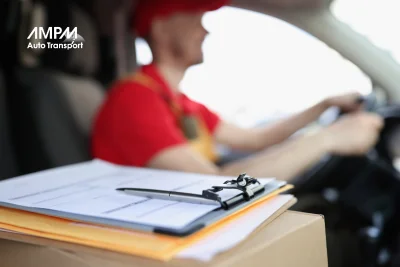
Car pickup can feel surprisingly quick. The carrier arrives, the driver walks around the vehicle, the driver adds a few notes to a form, and suddenly someone is asking for your signature. With moving boxes still open and a dozen other things competing for attention, it is tempting to sign wherever the driver points and move on. That is a mistake. The bill of lading is one of the most important documents in a vehicle shipment. It identifies the shipment, records key pickup and delivery information, and often includes notes about the car’s condition when the carrier takes possession of it.
Federal regulations require covered for-hire motor carriers to issue a receipt or bill of lading for property accepted for interstate or foreign transportation. The required information includes the names of the consignor and consignee, the origin and destination, a description of the freight, and certain quantity or measurement details. In everyday auto transport, the form may also show the vehicle identification number, mileage, carrier information, inspection notes, payment details, and signatures from the pickup and delivery contacts. The exact layout varies because there is no single universal bill of lading form used by every auto transport company.
So, what is a BOL in car shipping, and why does it deserve more than a quick glance? Think of it as the written record of the vehicle’s journey. It shows what the carrier accepted, where the driver picked up the vehicle, where the vehicle traveled, and what the parties acknowledged along the way. That record can become especially important when there is a disagreement about vehicle condition, delivery, payment, or the terms of transportation.
What Is a Bill of Lading and Why Does It Matter?
BOL stands for bill of lading. The word “lading” refers to cargo that people load for transportation. In this case, the cargo is the vehicle. The simplest BOL meaning is a document confirming that a carrier received property for transportation. Federal Motor Carrier Safety Administration guidance also describes a bill of lading as a receipt for goods and a contract for their transportation in the household-goods context. A vehicle-shipping document may perform several jobs at once. It can identify the people involved in the shipment, describe the vehicle, show the pickup and delivery locations, record its visible condition, and confirm that custody has passed from one party to another.
That is why the question “What is a bill of lading used for?” does not have a one-line answer. It creates a record of the shipment. At pickup, the document helps establish which vehicle the carrier accepted and what its visible condition appeared to be at that time. At delivery, it provides something to compare against before the receiving contact signs the final paperwork. The BOL may also contain terms related to payment, carrier responsibility, personal items, inspection procedures, claims, and delivery. Those terms can vary, so the customer should read the actual document rather than relying only on a phone conversation or an earlier quote. A quote gives you an estimate of the expected transportation cost. A dispatch notice tells you which carrier the company may assign.
The bill of lading documents the shipment when the carrier takes possession of the vehicle. That timing is important. Imagine that a customer notices a scratch after delivery. The first questions will usually be straightforward: Was the mark already present? Did the driver record it at pickup? Did the customer note it during the delivery inspection? Are there dated photographs? The BOL may not answer every question on its own, but it gives everyone a shared starting point.
Federal law also connects carrier liability for actual loss or injury to property with the receipt or bill of lading that the carrier issues for transportation. A carrier’s failure to issue the document does not automatically erase the liability established under the law. That does not mean every mark automatically becomes an approved claim. Evidence, the document’s terms, the vehicle inspection, photographs, exclusions, and the circumstances of the shipment may all matter. That means you should not treat the paperwork casually. The BOL also helps distinguish the roles of the people involved.
The consignor is generally the party sending or tendering the property for transportation. The consignee is the party receiving it. Sometimes that is the same customer at two different locations. In other shipments, a dealership, auction, family member, employee, or other authorized contact may handle one side. Names and phone numbers need to be accurate. A driver may not be able to release the vehicle to someone the carrier cannot identify or authorize for delivery. Pickup and delivery locations matter for the same reason. The origin and destination written on the document should match the agreed route. When a large auto carrier cannot access a residence, the physical inspection may take place at a nearby parking lot or wide street. The paperwork should still clearly identify the shipment and show where the transfer occurred.
Covered carriers must retain records of the federally required bill-of-lading information. Current federal recordkeeping rules generally list copies of bills of lading and similar freight documents with a one-year retention period. Customers should keep their copies too. Do not delete the electronic version or throw away the paper form as soon as the vehicle unloads. Keep it with the quote, photographs, payment records, and other shipping documents until you complete the transaction and resolve any concerns.
What Appears on a Car Shipping Bill of Lading?
No single BOL design covers the entire auto transport industry. One carrier may use a paper form with a vehicle outline. Another may complete the inspection on a phone or tablet and send an electronic copy by text or email. The appearance can change. The basic purpose does not. Federal regulations establish minimum information for covered for-hire interstate motor carriers, including the consignor and consignee names, origin and destination points, number of packages, freight description, and weight, volume, or measurement when applicable to the freight rating. An auto transport BOL will often include additional details because carriers need to identify and inspect a vehicle in ways that general freight does not require.
Shipment and Contact Information
The form will normally identify the pickup and delivery parties. Review the names, phone numbers, and locations before signing. A small typing error may seem harmless until the driver is trying to coordinate delivery with the wrong number.
The document may also include:
- A shipment or order number
- The carrier’s name
- Pickup and delivery addresses
- Scheduled or actual pickup date
- Delivery date
- Driver information
- Payment status or amount due
- Special instructions
Not every detail is federally required under the general motor-carrier BOL rule. Carriers add some fields to manage the shipment or document the agreed terms. Make sure the written information reflects the actual arrangement. For example, do not ignore a delivery address from an earlier version of the quote. Do not assume the driver will remember a special instruction that appears only in a text message. Ask for a correction when an important detail is wrong.
Vehicle Identification Details
The BOL should clearly identify the vehicle being transported. That usually means recording the year, make, model, and vehicle identification number. The form may also show the license plate, exterior color, odometer reading, unit number, or auction stock number.
Check the VIN carefully. A single incorrect character can create confusion, especially when a carrier transports several similar vehicles. Dealership, auction, fleet, and commercial shipments may include multiple cars of the same make or color.
The form may also describe the vehicle’s operating condition. A car may appear as running, inoperable, unable to steer, unable to brake, or requiring additional loading equipment. These details matter because they affect how the carrier loads and removes the vehicle from the trailer.
The written description should match reality. Do not describe a vehicle as fully operational if it starts but cannot move under its own power. The driver and carrier need accurate information, particularly when they need a winch or special loading arrangement.
The Pickup Condition Report
For most individual customers, the inspection section deserves the closest attention. The driver typically walks around the vehicle and records visible scratches, chips, dents, scuffs, cracked glass, paint issues, or other existing damage. Some digital inspections also include photographs alongside the written notes or vehicle diagram.
This inspection does not provide a complete mechanical assessment. The driver does not diagnose transmission problems, test every electrical feature, or remove panels to look for hidden damage. Instead, the inspection usually documents the vehicle’s visible exterior condition before loading.
A clean vehicle makes the inspection easier. Dust, snow, mud, or heavy road grime can hide marks and make the inspection less precise. Poor lighting can create the same problem.
Wash the exterior before pickup when practical. Take your own dated photographs in clear light, including wide views of each side and closer images of existing damage. Then walk around the car with the driver. Do not stand several feet away while the driver completes the inspection.
Look at the areas the driver marks and ask questions when a note seems unclear. Terms such as scratch, chip, dent, scuff, ding, or paint damage can have different meanings. The location should also provide enough detail to identify the damage later. A note that says “left side” is vague. A note identifying a scratch on the left rear door is much more useful.
Signatures and Transfer of Custody
The pickup signature generally confirms that the customer released the vehicle to the carrier and reviewed or acknowledged the recorded information. The driver may sign as the carrier’s representative. The customer, dealership employee, auction agent, family member, or another authorized person may sign as the releasing party.
Read the language near the signature field. A signature may acknowledge more than the condition diagram. It may also confirm receipt of the vehicle, acceptance of written terms, the accuracy of shipment details, or the presence of personal property. Treat electronic signatures with the same attention as paper signatures.
A phone screen may show only part of the document at once. Scroll through the form. Ask to view the complete inspection and terms before adding your name. After signing, request or save a copy immediately. Do not depend on being able to retrieve it later from a text thread, app, or temporary web link.
Delivery Inspection and Final Notes
The BOL returns to the center of the process when the car reaches its destination. The receiving contact should compare the vehicle with the pickup inspection and photographs before signing the delivery section. Walk around the vehicle slowly. Look at the bumpers, doors, mirrors, rocker panels, roof, wheels, windshield, and other glass. Pay attention to areas near the loading points and tie-down locations, but inspect the entire exterior rather than looking only where damage seems most likely. Daylight helps. When delivery happens after dark, use a flashlight and move the vehicle to a well-lit area if that can be done safely. Any new concern should be written on the delivery BOL before the receiving contact signs it. A verbal comment to the driver is not the same as a written notation. Writing “damage noted” is also less useful than identifying the specific area and type of damage.
Take photographs before the carrier leaves. The delivery signature generally confirms that the vehicle was received. Signing a clean delivery inspection without recording a visible concern may make a later disagreement harder to evaluate. Do not invent damage or argue over ordinary dust. Just take the time to compare the vehicle carefully and document what you actually see.
How to Review the BOL at Pickup and Delivery
The paperwork becomes much easier to manage when you know what to look for before the carrier arrives. Start with the shipment information. Confirm the vehicle, VIN, pickup contact, delivery contact, origin, destination, and payment details. Check that the vehicle’s operating condition and any special loading instructions are accurate. Then review the inspection. Compare the driver’s notes with the car itself. Look at each marked area rather than assuming the diagram is correct. When existing damage is missing, ask for it to be added. Do not be embarrassed about taking a few extra minutes.
A careful inspection is not an accusation against the driver. It protects both sides by creating a clearer record. Photographs should support the BOL, not replace it. Take pictures before the car is loaded, but also make sure visible condition is recorded on the document. A phone gallery filled with photos may help establish timing and condition, while the BOL shows what was acknowledged during the transfer. Keep personal belongings out of the inspection process whenever possible. Loose items inside a car can shift, break, disappear from view, or create disagreements later. Personal property may also be handled differently from the vehicle under the carrier’s terms.
When something has been approved to remain inside, make sure the written terms are clear. Do not assume the BOL creates an inventory of every bag or box unless the items are specifically listed. At delivery, use the pickup copy rather than relying on memory. A small mark that looks new may already be visible in an earlier photograph. Another mark may have been overlooked during the original inspection. Comparing records helps prevent both false alarms and missed concerns. When damage is visible, write a specific note before signing. Include the affected panel or area and the type of issue. Take several photographs from different distances and angles. Save copies of the pickup BOL, delivery BOL, quote, order confirmation, and relevant communication.
A notation on the delivery paperwork is important, but it may not be a complete claim by itself. Federal claim-processing rules state that a written cargo claim must provide enough facts to identify the shipment, assert liability for the alleged loss or damage, and request a specified or determinable amount of money. The claim must also be filed within the time limits that apply under the bill of lading, transportation contract, tariff provisions, or law. That means customers should read the claim instructions rather than assuming that a handwritten delivery note finishes the process. Report the concern promptly. Ask where a written claim should be sent and what supporting material is required.
Do not repair the vehicle immediately unless safety makes it necessary. The carrier or insurer may request photographs, estimates, an inspection, or other documentation before repairs begin. Keep communication factual. State what was observed, when it was discovered, where it was written on the BOL, and which photographs support it. Emotional language may be understandable, but clear documentation is more useful. There is another reason to review the BOL carefully: not every disagreement involves damage. The issue may concern the delivery address, payment method, vehicle condition, personal items, extra services, or who was authorized to receive the car. A well-completed form cannot prevent every dispute. It can remove some of the uncertainty that causes one.